
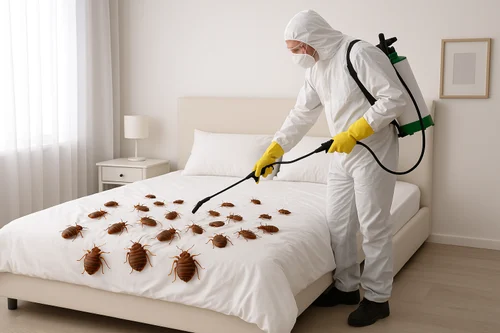
Bed bugs don't fly, don't jump, and don't care how clean your home is — which is exactly why they're one of the most misunderstood pests we treat. They're expert hitchhikers, and understanding how they actually travel and hide is the first step to catching an infestation before it spreads through an entire home.
How Bed Bugs Actually Get Into a Home
Bed bugs don't originate in a dirty house — they arrive from somewhere else. The most common entry points our technicians trace back are:
- Second-hand furniture and mattresses brought into the home
- Luggage after travel or hotel stays
- Used clothing and delivery cartons or moving boxes
- Shared walls or wiring conduits in apartment buildings, where bugs travel between adjoining units
A single fertilised female carried in on a suitcase is enough to start a new infestation within weeks.
Where Bed Bugs Actually Hide
Despite the name, bed bugs aren't limited to mattresses. They prefer tight, dark seams close to where people sleep or sit for long periods, including mattress seams and piping, the joints and frame of a bed, behind headboards and skirting boards, inside electrical sockets and switch plates near beds, and the seams of sofas, cushions and curtain folds. They can flatten their bodies to hide in gaps as thin as a credit card.
Early Signs of a Bed Bug Infestation
Because bed bugs are nocturnal and hide expertly during the day, most people notice the indirect signs long before they see a live bug: small rust-coloured or dark spots on sheets (digested blood spots left behind), tiny pale, shed exoskeletons near seams, a faint sweet, musty odour in a heavily infested room, and, most commonly, small clusters or lines of itchy red bites appearing on the skin after sleeping, often on arms, shoulders and legs.
Why Bed Bug Bites Are Easy to Mistake for Something Else
Not everyone reacts to bed bug bites immediately — some people show marks only days later, others not at all, which is why relying on bites alone to confirm an infestation is unreliable. A physical inspection of the mattress seams, bed frame and surrounding furniture is a far more accurate way to confirm activity.
Why Bed Bugs Are So Hard to Get Rid of on Your Own
Bed bugs survive for months without feeding and can go into a dormant state when conditions are unfavourable, which is why store-bought sprays that only kill on contact often leave enough of the population untouched to rebuild. Eggs are also resistant to many surface treatments, and because bed bugs can travel between adjoining rooms through wall voids and wiring gaps, a partial DIY treatment in one room can simply push the infestation sideways into another.
What a Professional Bed Bug Treatment Involves
NPMS begins every bed bug case with a detailed physical inspection of the mattress, bed frame, upholstery and adjoining walls to map every active hiding spot before any product is used. Treatment typically combines a residual insecticide application to seams, joints and voids with steam treatment, which uses high-temperature steam to kill bugs and eggs on contact in fabric and upholstery without chemical residue. For heavier infestations, we recommend a second follow-up visit roughly 10–14 days later to catch any bugs that hatched from eggs laid before the first treatment, since eggs are naturally more resistant than adult bugs.
What You Should Do Before the Technician Arrives
Wash all bedding, curtains and washable fabric on the hottest safe setting and dry on high heat, vacuum the mattress seams and surrounding floor thoroughly and dispose of the vacuum bag outside, and avoid moving furniture between rooms, which can spread bugs into previously unaffected areas. Do not throw away the mattress or furniture before the inspection — in many cases it can be treated rather than replaced.
How to Prevent Bed Bugs From Coming Back
After travel, inspect luggage and clothing before bringing them into the bedroom, and consider a protective, zippered mattress encasement, which traps any surviving bugs and starves them out over time. Inspect second-hand furniture carefully before bringing it indoors, and if you live in an apartment building, ask neighbours or your housing society about any reported activity — shared walls mean bed bugs rarely stay contained to a single unit.
Bed bugs spread fast once established, and DIY treatments frequently push them into neighbouring rooms instead of eliminating them. NPMS's combined steam and residual treatment targets every hiding spot in a single visit — book a confidential inspection today.
Frequently Asked Questions
Can bed bugs spread from one flat to another in an apartment building?
Yes. Bed bugs can travel through wall voids, electrical conduits and shared corridors, which is why infestations in apartment buildings often need to be treated across adjoining units to fully resolve.
Do I need to throw away my mattress if I have bed bugs?
Not necessarily. Most mattresses can be treated effectively with steam and residual insecticide rather than replaced. A protective mattress encasement afterwards helps prevent re-infestation and protects your investment.
How many treatment visits does bed bug removal usually take?
Most cases need two visits roughly 10–14 days apart, since bed bug eggs are more resistant to treatment than adults and the second visit targets anything that hatched after the first.